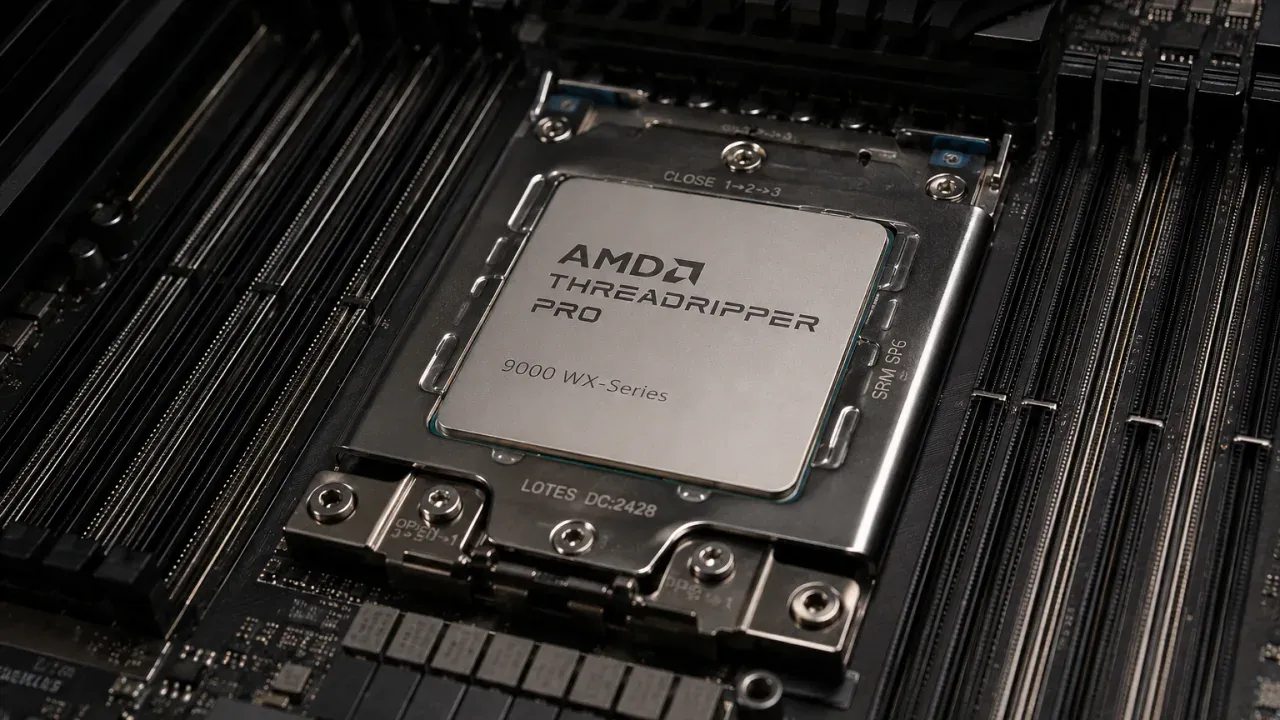
AMD’s next workstation platform, codenamed Mustang Peak, will move to the new TR6 socket with Zen 6 architecture and PCIe 6.0 support. Expected around 2027, this shift represents a massive platform overhaul rather than a simple refresh, bringing potential 144-core flagships and pushing clock speeds toward 7 GHz.
Current Threadripper 9000 owners on TRX50 or WRX90 motherboards face a definitive dead end. The transition to PCIe 6.0 doubles transfer rates to 64 GT/s, demanding rigorous board layouts, enhanced signal integrity, and new retimers. This mechanical and electrical leap means Mustang Peak requires entirely new motherboards, killing any hope of a simple BIOS-based upgrade for existing HEDT or Pro buyers.
Leaked AMD documentation, discovered in the company's technical portal by InstLatX64 and detailed by Tom's Hardware, confirms the use of 2nm process nodes and Zen 6 cores. Moving from 8 to 12 cores per compute chiplet means a 12-CCD Threadripper Pro flagship could theoretically reach 144 cores and 288 threads.
According to a leak from the Moore’s Law is Dead channel citing a document purportedly from Q1 2026, AMD is targeting a staggering 7 GHz clock speed for Zen 6. Reaching this frequency would break the 7 GHz barrier for the first time in the industry. Sources indicate AMD aims to hit this speed with "at least one Zen 6 product."
Hardware enthusiasts have obsessed over core counts for a decade, but massive CPUs like the current 96-core 9995WX already struggle to utilize their full potential in many standard workflows. The true value of Mustang Peak isn't the speculative 144-core count; it’s the underlying data pipeline.
By doubling PCIe bandwidth to 256 GB/s per x16 link and potentially introducing MRDIMM support, AMD is finally ensuring that multi-GPU rendering farms and massive NVMe arrays don't starve the processor. When you have 144 cores demanding data, quad-channel DDR5 simply isn't going to cut it. The platform needs to evolve, and TR6 is that evolution.
If you are running a standard desktop processor for heavy 3D rendering or video editing, Mustang Peak will remain massive overkill. But for professional studios, the promise of PCIe 6.0 and 144 cores means you can consolidate multiple physical machines into a single workstation without pipeline bottlenecks.