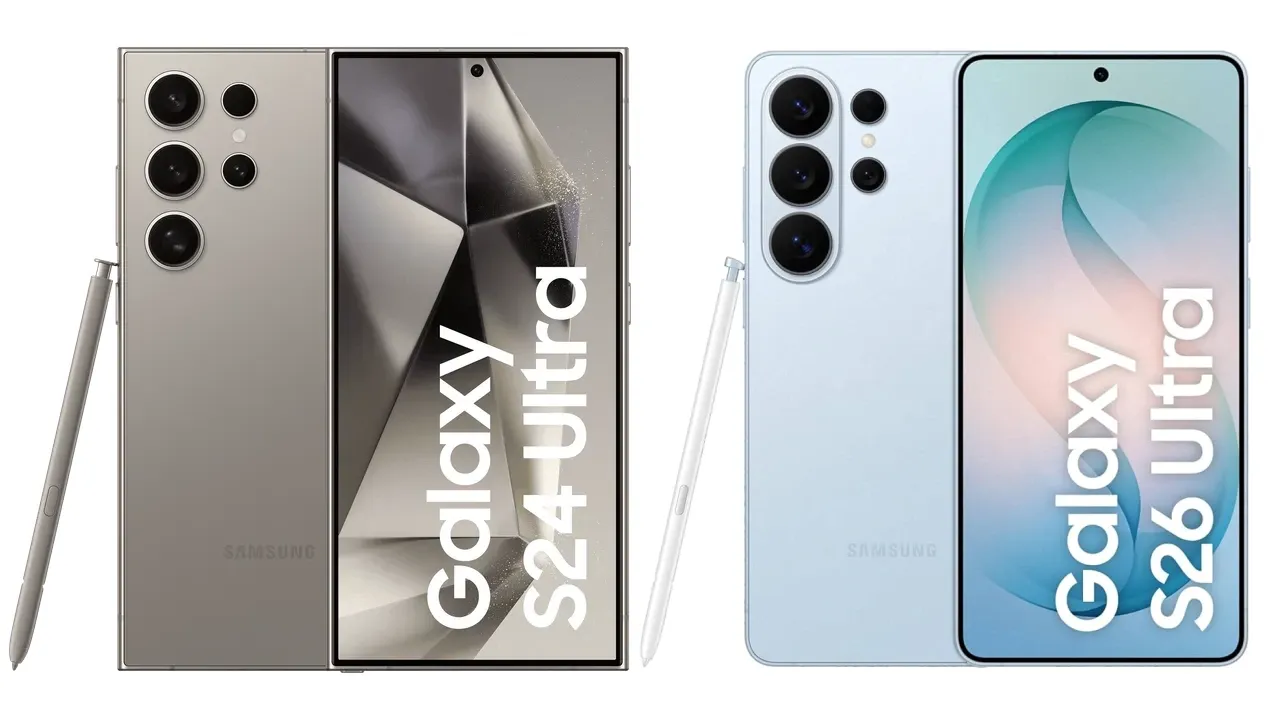
The question of whether the Galaxy S26 Ultra is worth upgrading to from the Galaxy S24 Ultra comes down to real hardware changes, not marketing claims. On paper, the newer model introduces a 3nm Snapdragon 8 Elite Gen 5 chip, a brighter 6.9-inch display, upgraded cameras including a 50MP ultra-wide sensor, and faster charging speeds up to 60W.
At the same time, the Galaxy S24 Ultra already delivers a 6.8-inch QHD+ AMOLED panel, Snapdragon 8 Gen 3 performance, a 200MP main camera, and a large 5000mAh battery. That makes this comparison less about necessity and more about incremental improvements that may or may not matter in daily use.
Design and Display Changes
The Galaxy S26 Ultra shifts slightly in physical design, moving to a slimmer 7.9mm body and reducing weight to around 214 grams. The S24 Ultra is noticeably heavier at 232 grams with a thicker frame. The change from a boxy design to more rounded edges is subtle, but it does affect hand feel over long use.
Read Also:- Oppo Find N6 Launched With 6,000mAh Battery, 200MP Camera and Zero-Feel Crease Hinge
Display size increases marginally to 6.9 inches, with resolution slightly bumped to 3120×1440. Both models retain a 1–120Hz adaptive refresh rate. Brightness sees a modest jump, potentially reaching up to 3000 nits in peak scenarios, compared to roughly 2600 nits on the S24 Ultra.
A notable addition is the privacy display layer on the S26 Ultra, which limits side-angle visibility. Gorilla Glass Armor 2 also replaces the earlier protection, offering incremental durability gains.
Performance and Hardware Upgrades
This is where the most visible generational change appears. The S26 Ultra runs on a 3nm Snapdragon 8 Elite Gen 5 processor, compared to the 4nm Snapdragon 8 Gen 3 in the S24 Ultra. The GPU also sees an upgrade from Adreno 750 to Adreno 840.
In practical terms, this translates into better sustained performance, improved thermal efficiency, and stronger AI processing. The addition of a 16GB RAM variant on the S26 Ultra further positions it for heavier multitasking and future software demands.
Read Also:- Motorola Signature Launched in India: Snapdragon 8 Gen 5, Quad 50MP Cameras, 165Hz Display at ₹59,999
However, for everyday tasks like browsing, video streaming, or social apps, the difference is less noticeable. The S24 Ultra is still fast enough for most users, even under moderate workloads.
Camera Improvements
Samsung keeps the 200MP primary sensor on both devices, but the S26 Ultra uses a wider f/1.4 aperture, allowing more light capture in low-light conditions. This should improve night photography and reduce reliance on aggressive processing.
The biggest upgrade comes in the ultra-wide camera, which jumps from 12MP on the S24 Ultra to 50MP. This significantly enhances detail in wide-angle shots and improves consistency across camera lenses.
The periscope telephoto also benefits from a brighter f/2.9 aperture, compared to f/3.4 on the older model, aiding zoom performance in dim lighting. The 3x telephoto and front camera remain largely unchanged.
Overall, camera improvements are meaningful but not transformative unless you frequently rely on ultra-wide or low-light photography.
Battery and Charging
Battery capacity stays the same at 5000mAh, which means endurance is expected to remain similar between both devices. However, charging speeds are noticeably faster on the S26 Ultra.
Read Also:- OPPO A6 Pro 5G Launched in India: Dimensity 6300, 7,000mAh Battery, 80W Charging
Wired charging increases to 60W from 45W, and wireless charging moves up to 25W. Reverse wireless charging remains unchanged. These upgrades reduce downtime rather than extending usage time.
Software and AI Capabilities
The S26 Ultra ships with Android 16 and One UI 8.5, compared to Android 14 and One UI 6.1 on the S24 Ultra. Both devices are supported with seven years of updates, ensuring long-term usability.
The difference lies in AI capabilities. The newer model integrates more advanced on-device AI features, improving tasks like real-time translation, image editing, and contextual suggestions. While the S24 Ultra supports Galaxy AI, its capabilities are more limited in comparison.
Connectivity and Build Differences
Both devices support 5G, Wi-Fi 7, and UWB. The S26 Ultra upgrades Bluetooth to version 6.0, offering improved efficiency and stability.
Interestingly, Samsung switches from a titanium frame in the S24 Ultra to aluminum in the S26 Ultra. While this contributes to weight reduction, it may slightly impact perceived premium feel.
Real-World Impact
For users coming from older devices, the S26 Ultra offers a well-rounded package with improvements across performance, camera versatility, and charging speed. The lighter design and refined display also contribute to everyday usability.
For existing S24 Ultra users, the experience remains largely similar in daily scenarios. App performance, battery life, and core functionality do not change dramatically enough to feel like a new category of device.
The upgrade makes more sense for those who prioritize cutting-edge AI features, improved ultra-wide photography, or faster charging cycles.
The Galaxy S26 Ultra is objectively more advanced, with better performance, a stronger ultra-wide camera, faster charging, and improved AI capabilities. However, the Galaxy S24 Ultra still holds up well across all essential areas.